... your congress, your exhibition, your competition: An individually produced medal will bestow a special importance on the occasion you wish to celebrate.
This uniquely crafted piece of work will serve as a long-lasting memory of your anniversary, opening or congress.
Special efforts deserve a special distinction
Show your appreciation in dazzling style. An individually struck medal is not only a gift but also a token of distinction:
You can choose from a variety of materials such as gold, silver or its alloys, platinum, but also copper or bronze, gold or silver-plated. Packaged in cases with certificates of authenticity, they will make for a worthy memory of your special occasion.
Time passes, value endures.
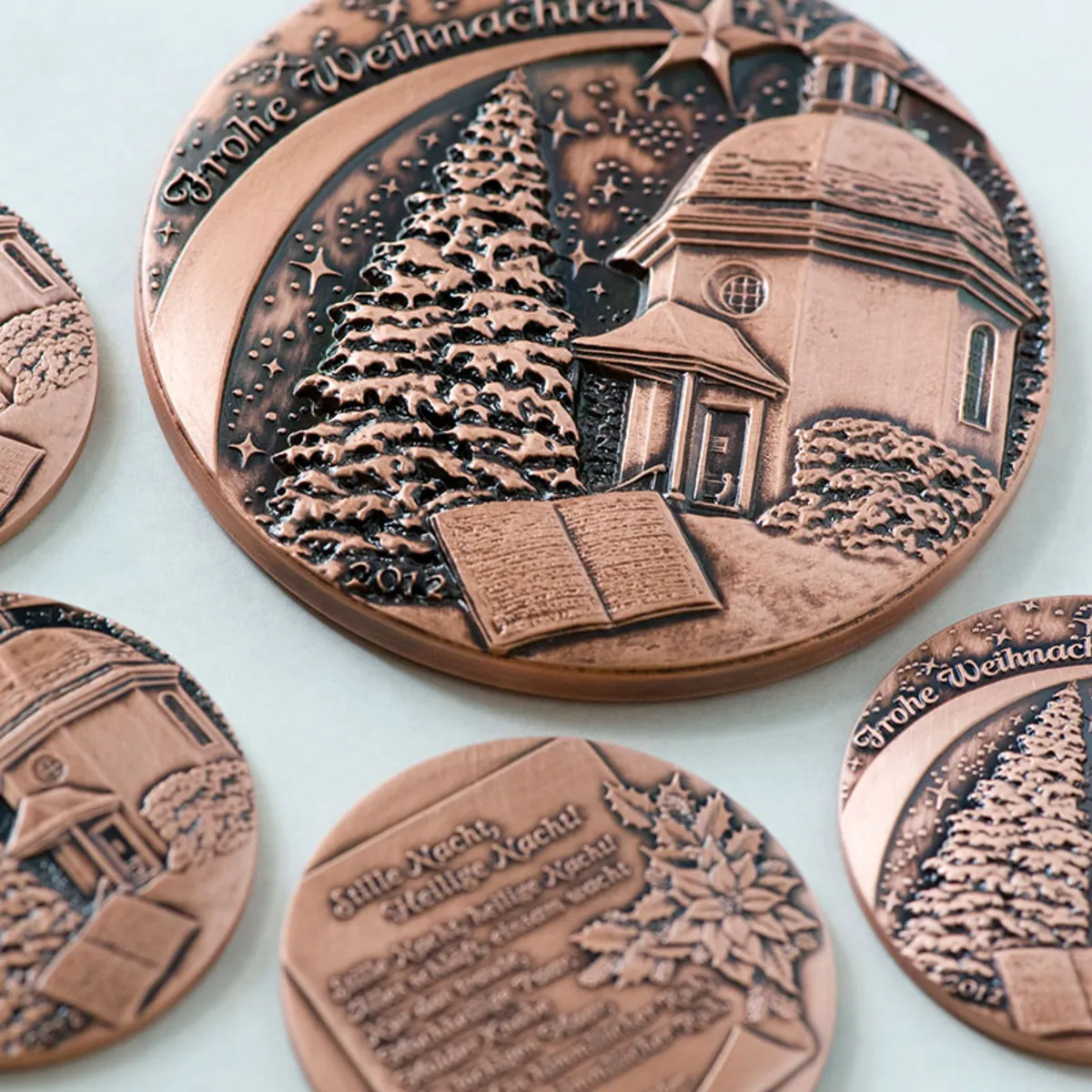
We carry out all the steps in the production process in perfect harmony.
Our service: design - tools - blank production - striking - finishing
Based on your ideas, our artists create the design. A master engraver carefully transforms it into a relief - the plaster model. Simple designs are transformed directly into digital data. High-precision tools are used to cut the relief into tool-grade steel. In this way the design is cut into the steel mold, which is then hardened. At the same time, the blanks are stamped out of a strip of metal and prepared for minting.
Before minting, the surfaces of the dies are prepared (polished, sand-blasted or abraded). Afterwards, the dies are fixed in the minting machine.
The blanks are fed into the minting machine and struck at a force of up to 12,000 kN. The experienced professionals at the Austrian Mint have a variety of machines at their disposal.
After the final quality control (and, if necessary, further finishing), the medals are carefully packaged.
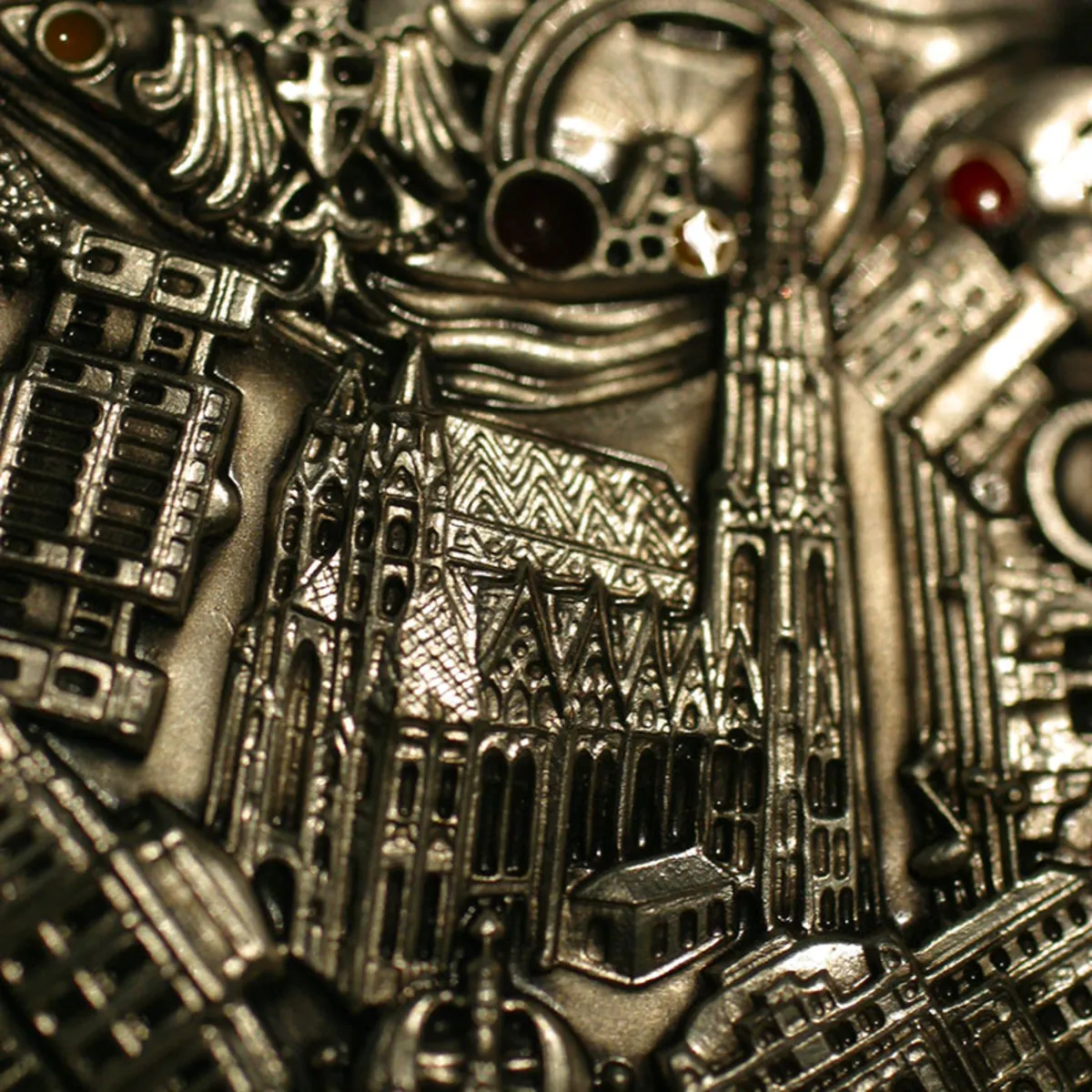
The medals produced by the Austrian Mint are of an exceptional quality, the fruit of vast experience and technical and artistic prowess.
Strips of metal are the prematerial for the production of the blanks. Blanks are cut from the strip of metal, which has been rolled to the required thickness. The blanks are rimmed and then annealed to dissolve the worn hardened micro-structure. Finally, the blanks are surface-treated, either ball polished, washed or brushed. This final treatment is very important for the necessary minting quality, which shall be achieved.
When minting medals, each strike requires a force of up to 12.000 kN. This is significantly higher than with coins. Large medals with high relief will be struck up to four times. After each strike, the medals are annealed, pickled and cleaned. The exact force of each strike depends on the relief, the material used and the diameter.
Splash minting/classical medal
High relief – diameter: up to 120 mm
Fly press/Hydraulic press
This minting technique does not use a collar. Therefore the material can flow outside the motif, producing an irregular edge.
Alternatively, for clients who require a perfectly round medal, the rough edge can be smoothed down on a grinder and adapted to the desired diameter. This technique is known as French style splash minting and is also used for minting perfectly round medals
Minting using a collar/coin-like medals
Coin-like relief – diameter: max. 50 mm
Knuckle joint press
Using this minting technique, a collar limits the sideways flow of material during the minting process in order to produce a rim. This rim is higher than the highest part of the motif and protects the medal from damage.
Surface finishing
Medals can be upgraded by coating them in silver, gold or rhodium plating. Parts of the motif can be also highlighted by gold plating or colouring.
Silver medals are mostly lacquered in order to avoid tarnishing.
Other special coatings are available depending on the material used.
Patination (Artificial ageing)
The minted relief appears more three-dimensional if the medal is patinated. The first step is to dip the medal into a special liquid, which makes the medal dark all over. The surface is then very smoothly polished by hand using a soft cloth and a special powder. Lower-lying parts of the motif cannot be reached by the cloth, and the emerging contrast gives the medal a lively three-dimensional effect.